

Solid Wood vs. MDF, Plywood, and Particleboard: What Are You Really Paying For?
Not all wood furniture is made the same way. A practical look at materials, durability, repairability, cost, and when solid wood is actually worth the investment.
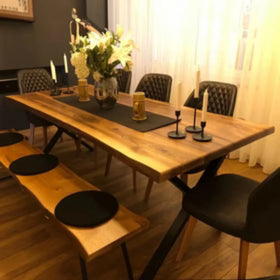
Imagine standing in front of two dining tables that look almost identical. Both have a beautiful walnut-colored surface, clean edges, and a simple modern design. One costs considerably more than the other. At first glance, it is difficult to understand why.
The difference may not be in the shape or appearance. One table might be made from solid walnut, while the other uses a wood veneer over MDF or another engineered panel. From a distance, both can create a similar impression, especially in carefully styled photographs.
So why pay more for solid wood?
The usual answer is that solid wood is stronger, more natural, and longer-lasting. There is some truth in that, but the full picture is more interesting. Solid wood has meaningful advantages, particularly for furniture intended to be used and maintained over many years. It also has disadvantages that are often overlooked in product descriptions.
Meanwhile, MDF, plywood, and particleboard are not interchangeable materials, and they are not automatically poor choices. Each has characteristics that can make it useful in the right application.
If you are buying a dining table, coffee table, bookcase, or storage cabinet, understanding these differences can help you decide where the extra investment is worthwhile and where it may not be necessary.
First, What Does Solid Wood Actually Mean?
Solid wood furniture is made from natural timber rather than a core manufactured from compressed fibers or wood particles.
A solid walnut dining table, for example, may use multiple walnut boards joined together to create a wider tabletop. The finished surface still consists of genuine walnut throughout its thickness. It is not necessarily cut from one enormous piece of wood, and it does not need to be.
This distinction matters because some furniture descriptions create the impression that anything made from several joined boards is somehow less authentic. In reality, joining properly selected boards is a normal and practical way to construct wide solid wood surfaces.
Common furniture hardwoods include walnut, oak, beech, ash, and maple. Pine is also widely used, particularly for rustic and farmhouse furniture, although it is generally softer than those hardwoods.
Different species have different densities, hardness levels, colors, grain patterns, and working characteristics. Even within solid wood furniture, the material alone does not guarantee the same level of performance.
A carefully constructed pine table and a poorly constructed oak table should not be judged only by the names of their wood species.
The quality of the lumber, drying, joinery, finish, and design all matter.

What Are MDF, Plywood, and Particleboard?
These materials are often grouped together under the broad term "engineered wood," but they are manufactured differently and perform differently.
MDF (medium-density fiberboard) is made from wood fibers combined with binders and pressed into dense panels. It has a relatively uniform internal structure and a smooth surface that is particularly useful for painted furniture.
Particleboard, sometimes called chipboard, is manufactured from wood particles bonded into panels. It is commonly used in affordable flat-pack furniture, shelving, and cabinet components, often beneath a melamine or laminate surface.
Plywood is made from thin layers of wood veneer bonded together, generally with the grain direction alternating between layers. Good-quality furniture plywood can be strong and dimensionally stable, making it useful for cabinets, drawers, and other structural panels.
Wood veneer is different again. It is a thin layer of real wood applied over a substrate such as plywood or MDF. A genuine walnut veneer can display authentic walnut grain, even though the furniture beneath it is not solid walnut throughout.
That means a veneered table is not automatically fake wood. It may have a real wood surface, but its construction and repair possibilities differ from those of a solid wood table.
The important thing is understanding what each piece is made from rather than treating all wood-based products as the same material.
Solid Wood vs. Engineered Wood: A Quick Comparison
Before exploring the details, here is a simplified overview of how these materials typically compare.
| Material | Main Advantage | Main Limitation | Often Suited To |
|---|---|---|---|
| Solid wood | Natural character and repairable thickness | Higher cost and seasonal movement | Dining tables, coffee tables, frames, long-term furniture |
| MDF | Smooth, uniform surface for painting | Vulnerable to moisture damage, especially at exposed edges | Painted cabinet doors, decorative panels |
| Plywood | Good strength and dimensional stability | Quality varies; visible edges may need finishing | Cabinets, shelves, storage furniture |
| Particleboard | Affordable and widely available | More limited repairability and potential moisture-related swelling | Budget shelving and flat-pack furniture |
| Wood veneer over a panel | Genuine wood appearance with a stable panel core | Thin decorative layer limits deep sanding | Cabinets, desks, modern furniture panels |
These are broad tendencies, not guarantees.
A high-quality plywood cabinet can outperform a poorly designed solid wood cabinet. Similarly, a carefully manufactured MDF panel may be a better choice for a large painted door than a solid wood panel that needs to accommodate substantial seasonal movement.
The construction, panel grade, finish, and intended use determine the final result.
Why People Choose Solid Wood Furniture
Solid wood's appeal is not based on one characteristic. It is a combination of material appearance, construction possibilities, long-term maintenance, and the experience of living with natural timber.
Some of its advantages are immediately visible. Others become more important after several years of use.
1. The Material Goes Beyond the Surface
When you look at a solid walnut tabletop, the grain belongs to the timber itself. It does not end at a thin decorative layer.
This changes the way edges, curves, and details can be designed.
A thick solid wood tabletop can have rounded corners, a bullnose edge, or a deeply shaped profile while still revealing the same material throughout. A sculptural leg or pedestal can also be formed from solid wood components, allowing grain and natural color to contribute to the design from multiple angles.
Furniture made from veneered panels can also have attractive edges, but those edges usually need to be designed with the veneer thickness, substrate, and any applied edge treatment in mind.
Neither approach is inherently more beautiful.
The difference is that solid wood offers a particular kind of material continuity. What you see at the surface is also what exists beneath it.
For people who appreciate natural grain, that can be an important reason to choose solid wood.
2. Solid Wood Can Often Be Repaired Instead of Replaced
Imagine using the same dining table for ten years.
During that time, the surface may collect small scratches, dents, worn areas, or marks from ordinary use. Some people enjoy these signs of age. Others would prefer to restore the table's original appearance.
One of solid wood's strongest advantages is the potential for repair.
Depending on the depth of the damage and the type of finish, a solid wood surface can often be sanded, locally repaired, or refinished. Because the timber continues beneath the surface, there is usually more usable material available for restoration.
A veneered surface offers less room for sanding because its decorative wood layer is comparatively thin. Aggressive sanding can expose the underlying panel.
MDF and particleboard can sometimes receive cosmetic repairs, but damaged edges, swollen sections, or deteriorated internal material may be difficult to restore to their original condition.
This does not mean every solid wood table can be repaired indefinitely. Deep cracks, failed joints, severe water damage, and poorly designed construction can still be serious problems.
However, the possibility of restoring an existing piece rather than replacing it is a meaningful advantage, particularly for furniture used frequently.

3. Solid Wood Makes Long-Term Ownership More Flexible
A dining table is not necessarily purchased for one version of your home.
You may move to a different house, change your chairs, redecorate, or decide that a darker wood finish would work better in a new room.
A well-constructed solid wood table can sometimes adapt to those changes.
Its finish may be renewed, minor damage repaired, and certain components serviced or replaced where the design allows. A durable table that can accommodate changes in taste or use may remain relevant for longer than one purchased primarily for a temporary style.
There is also something practical about being able to maintain the same familiar piece rather than beginning again whenever its surface shows wear.
Of course, this depends on the actual furniture. A table with weak joints or an unstable base will not become a long-lasting purchase simply because its tabletop is solid wood.
Material quality is a starting point, not a substitute for sound construction.
4. Natural Grain Gives Each Piece Its Own Character
Manufactured finishes offer consistency, which is often useful. Natural wood offers variation.
Walnut can contain areas of deep brown alongside warmer tones and lighter sapwood. Oak may have pronounced grain, while beech often displays a subtler texture. Pine frequently includes knots and changes in grain direction.
Even two tables made from the same species may not look identical.
For some buyers, this individuality is one of the most appealing aspects of solid wood furniture. The grain is not repeated according to a printed pattern, and the natural color transitions can make an otherwise simple shape feel distinctive.
But this advantage comes with an important condition: you need to be comfortable with variation.
If you want every furniture panel to have an identical color and pattern, solid wood may not be the easiest material to specify.
That is one reason uniform engineered surfaces remain useful.
Where MDF and Plywood Can Actually Be Better
It is tempting to stop the comparison here and conclude that solid wood is always the superior option.
That would be misleading.
Engineered wood products were developed partly because natural timber has limitations, particularly when large, flat, consistent panels are required.
MDF Is Excellent for Certain Painted Surfaces
Suppose you want a cabinet with large, smooth, painted doors.
A well-made MDF panel can provide a uniform surface without the visible grain or natural knots of timber. It can also be machined into decorative profiles and finished with a consistent painted appearance.
Unlike wide solid wood panels, MDF generally has relatively limited movement across its surface under normal indoor humidity changes. This can be an advantage when maintaining precise, uniform panel dimensions.
For a painted cabinet door or decorative panel, solid wood may not provide a meaningful improvement in appearance or function.
In some designs, MDF may be the more appropriate material.
Its limitations become more important when moisture exposure, unsupported spans, edge fastening, or repeated assembly are involved. Those details need to be considered during design rather than ignored because the panel looks good after painting.
Plywood Can Be a Very Good Structural Material
Plywood deserves particular attention because it is sometimes incorrectly placed in the same quality category as inexpensive particleboard.
Good-quality plywood can offer an excellent combination of strength, stability, and versatility.
Its cross-laminated construction helps reduce movement compared with a wide solid wood panel, making it useful for cabinet bodies, drawer components, shelves, and large flat surfaces.
For a built-in storage wall, a kitchen cabinet, or certain modern furniture designs, plywood may be a sensible choice.
The quality varies substantially, however. The wood species, number of layers, adhesives, internal voids, veneer quality, and panel grade all influence performance.
A product described simply as "plywood" does not provide enough information to judge its quality.
The same principle applies to solid wood: material labels alone tell only part of the story.
The Disadvantages of Solid Wood That Are Worth Knowing
Anyone considering solid wood furniture should understand its limitations before making the investment.
A good purchase decision should consider what you will gain and what you will need to manage.
1. Solid Wood Usually Costs More
This is the most obvious disadvantage.
Quality hardwood can be expensive, particularly when a design requires large boards, carefully matched grain, substantial thickness, or complicated shaping.
The material also needs appropriate drying, selection, machining, assembly, sanding, and finishing. Handmade production and custom dimensions can increase the labor involved.
For someone furnishing a temporary apartment or working within a tight budget, paying significantly more for solid walnut furniture may not be the most practical decision.
A well-made engineered-wood piece could meet the immediate need at a more comfortable price.
The important question is how long you expect to use the furniture and what you value during that time.
If you plan to keep a dining table for many years, the initial investment may make more sense. If the piece is temporary, lower-cost alternatives deserve consideration.

2. Solid Wood Moves with Changes in Humidity
Wood is a hygroscopic material, meaning it exchanges moisture with the surrounding air.
As indoor humidity changes, solid wood can expand or contract, primarily across the grain. This seasonal movement is normal and must be considered in furniture construction.
A properly designed tabletop allows for this movement through suitable joinery and fastening methods. A poorly designed one may develop excessive stress, distortion, or cracking.
This is an important distinction.
It would be inaccurate to say solid wood never warps or cracks. It can, especially when moisture conditions change substantially or when construction fails to accommodate movement.
Engineered panels such as MDF and plywood generally provide greater dimensional consistency in certain applications, although they are not completely unaffected by moisture.
For solid wood owners, maintaining reasonably stable indoor humidity and avoiding unnecessary exposure to water or heat are sensible precautions.
3. Solid Wood Requires Some Care
A solid wood dining table can handle everyday use, but it is not maintenance-free.
The surface finish plays a major role in protecting it from moisture, stains, and ordinary wear. Some finishes offer stronger resistance than others, and all have limitations.
Spills should generally be wiped promptly, hot objects should be placed on protective mats, and harsh cleaning products should be avoided unless recommended for the particular finish.
Over time, a table may also develop small marks or changes in appearance.
For someone who enjoys natural materials, this can be an acceptable part of ownership. For someone who wants a perfectly uniform surface with minimal attention, a different material or finish may be a more comfortable choice.
4. Solid Wood Can Be Heavy and Difficult to Move
A large solid wood table may be substantial, particularly when it has a thick tabletop or sculptural base.
This can be desirable for stability, but it can also make delivery, moving, and rearranging furniture more difficult.
However, solid wood is not automatically heavier than MDF. Dense MDF panels can be surprisingly heavy, and different wood species have significantly different densities.
Weight should be checked for the actual furniture piece rather than inferred from its material label.
A large table that requires two people to move should also be evaluated for doorway clearance, stairs, and assembly requirements before ordering.
5. Natural Variation Is Not for Everyone
Natural grain is often presented as an unquestionable advantage, but it is also a matter of preference.
Some people love irregular grain patterns, knots, color variation, and subtle changes that develop over time. Others prefer consistent surfaces that match closely across every cabinet door, drawer, or tabletop.
Neither preference is wrong.
If visual uniformity is the main priority, carefully selected veneer or manufactured finishes may be easier to match across a large furniture arrangement.
Solid wood can still be selected for relative consistency, but perfect repetition is not a realistic expectation.
What About Particleboard? Is It Always a Bad Choice?
Particleboard has a reputation for being inexpensive and less durable than other furniture materials. Sometimes that reputation reflects real weaknesses, particularly in low-cost furniture with poor edge sealing or weak connections.
But particleboard also has legitimate uses.
It allows manufacturers to produce flat, consistent panels at relatively low cost. When properly specified and protected, it can serve adequately in dry indoor environments, including certain shelving and cabinet components.
Problems tend to arise when the material is exposed to water, loaded beyond its design capacity, or repeatedly disassembled using fasteners that no longer hold securely.
A swollen particleboard panel is often difficult to restore fully. Damaged edges and failed fastener points may also limit repair options.
Still, a well-designed particleboard cabinet used appropriately can be a rational purchase. The problem is not necessarily the existence of particleboard; it is expecting a low-cost panel to perform like a different material under demanding conditions.
The better approach is to match the material to the intended use.
Does MDF Furniture Contain Harmful Chemicals?
This question deserves a careful answer because it is often discussed in exaggerated terms.
Some composite wood panels use adhesives that can emit formaldehyde. However, emission levels depend on the manufacturing process, resin system, panel type, and applicable product standards.
In the United States, regulated composite wood products, including MDF, particleboard, and certain hardwood plywood products, are subject to EPA TSCA Title VI formaldehyde emission requirements.
That means it is inaccurate to suggest that every MDF product is automatically unsafe or that solid wood furniture is universally free from chemical emissions.
Solid wood furniture may also contain adhesives, stains, coatings, or other finishing products.
If indoor air quality is a concern, look for reliable information about panel compliance and the finishes used, rather than relying only on whether a product is labeled "natural."
The more useful questions are what materials and adhesives are used, whether relevant emission standards are met, and how the completed furniture is finished.
Which Furniture Pieces Are Most Worth Buying in Solid Wood?
Not every piece in your home needs to be made from the same material.
One practical approach is to prioritize solid wood where its characteristics are most useful.
A dining table is a good example. It is used frequently, often occupies a prominent position in the room, and may benefit from future surface repairs or refinishing.
Coffee tables are another strong candidate, particularly when the design emphasizes natural grain, curved edges, substantial thickness, or sculptural wooden supports.
Wooden chairs, benches, and certain desk designs may also benefit from solid timber, provided the construction and joinery are appropriate.
For some large storage units, however, a combination of materials may make more sense. A cabinet might use plywood for its body, solid wood for exposed edges or structural components, and veneered panels for large flat surfaces.
That mixed construction is not automatically a compromise in quality.
It may be a thoughtful solution to the requirements of the design.
A simple way to think about it
| Furniture Purchase | What Matters Most |
|---|---|
| Everyday dining table | Durable construction, comfortable dimensions, repairable surface |
| Coffee table | Stable base, suitable finish, appearance and repairability |
| Painted cabinet | Consistent panel finish, stable doors, suitable hardware |
| Large bookcase | Shelf span, load capacity, fastening, anchoring |
| Home office desk | Surface durability, cable management, structure and dimensions |
| Temporary apartment furniture | Budget, portability, ease of assembly and replacement |
The best material is the one that supports the way the furniture will actually be used.

How to Tell What a Furniture Piece Is Really Made From
One of the biggest challenges with online furniture shopping is that descriptions can be vague.
Terms such as "wood finish," "walnut look," and "wooden furniture" do not necessarily reveal the construction.
A walnut-colored table might be solid walnut, walnut veneer over plywood, MDF with a decorative laminate, or another combination of materials.
None of those descriptions automatically tells you whether the furniture is well made.
But they describe very different products.
Before purchasing, look for answers to these questions:
-
What is the tabletop made from? Solid wood, natural veneer, MDF, plywood, particleboard, or a combination?
-
What material is used for the legs or base? The supporting structure may differ from the visible tabletop.
-
How are the edges finished? Are they solid wood, veneered, or covered with edge banding?
-
What type of surface finish is applied? This influences appearance, care, and potential repair.
-
How is the furniture assembled? Joinery, fasteners, and structural design affect long-term performance.
-
Can damaged components be repaired or replaced? This becomes important after years of use.
A good manufacturer should be able to explain the construction clearly.
If a product is described as a solid wood table but important components are made from engineered panels, the description should identify that distinction.
Transparency helps customers compare the actual product rather than the marketing language surrounding it.
Is Solid Wood More Sustainable?
Solid wood can offer environmental advantages, particularly when it comes from responsibly managed sources and is used in furniture that remains functional for many years.
Repairability can also reduce the need for replacement. Keeping the same table in use for a long time may avoid the resources associated with manufacturing and transporting another piece.
But material choice alone does not determine environmental performance.
The origin of the timber, forest management, transportation, adhesives, finishing products, manufacturing waste, and expected service life all matter.
Engineered wood products can also use wood fibers, smaller pieces, or manufacturing residues that might otherwise have limited applications. This can improve material utilization in some production systems.
On the other hand, some panel products are more difficult to repair, separate, or recycle after use because of their binders and surface treatments.
It would be too simplistic to claim that every solid wood product is environmentally better than every engineered wood alternative.
A more responsible way to evaluate furniture is to consider sourcing, construction, expected lifespan, maintenance, and what happens when the piece is no longer needed.
Furniture that is used for a long time and maintained rather than discarded has a meaningful advantage regardless of how fashionable its material may be.
When Is Solid Wood Worth the Extra Money?
The answer depends on what you expect from the furniture.
If you want a dining table that you can keep for many years, appreciate genuine wood grain, and value the possibility of future refinishing, solid wood can justify a higher initial cost.
If you are choosing a compact painted cabinet for an area with limited wear, a well-made MDF or plywood design may offer better value.
If your budget is tight or the furniture is intended for short-term use, an affordable particleboard product may be entirely reasonable.
And if you want the appearance of walnut across a large, perfectly flat panel, a high-quality walnut veneer over an appropriate substrate may offer an attractive balance between natural appearance and dimensional stability.
Solid wood is most worth considering when its long-term strengths are relevant to how you plan to use the piece.
That is a more useful reason to choose it than simply assuming it is always the best material.

Why We Work with Solid Wood at Tomruque
At Tomruque Wood Studios, solid wood is central to many of our furniture designs because we value the relationship between natural material, visible grain, and form.
When designing a walnut coffee table or a solid oak dining table, the timber is not simply a decorative surface. It influences the thickness, edges, base, proportions, and finished character of the piece.
We also recognize that working with solid wood involves responsibilities. Material selection, moisture content, joinery, surface preparation, and finishing all affect how a piece will perform. Natural variation is part of the material, but it does not replace the need for careful workmanship.
Our approach is to create furniture that makes thoughtful use of solid hardwood rather than treating the label alone as a promise of quality.
For those considering a long-term dining table, our solid wood dining table collection includes designs in different hardwoods, shapes, and proportions.
But the wider point is not that every piece of furniture should be made from solid wood.
It is that customers should understand the material they are choosing and why it suits the design.
Final Thoughts: Buy the Construction, Not Just the Material Label
Solid wood has real advantages. Its natural grain continues beneath the surface, it offers meaningful opportunities for repair and refinishing, and it can be an excellent material for furniture intended to remain in use for years.
It also has limitations. It can be expensive, it moves with humidity, it requires appropriate maintenance, and its natural appearance cannot be perfectly standardized.
MDF, plywood, particleboard, and wood veneer each have advantages of their own. Used appropriately, they can create attractive, functional furniture at different price points.
The mistake is not choosing an engineered wood product instead of solid wood.
The mistake is assuming that all materials offer the same performance, or that one material name tells you everything about the quality of a finished piece.
Before buying furniture, look beyond the surface. Understand what the tabletop, base, edges, and supporting structure are actually made from. Consider how the piece will be used, what maintenance it will require, and whether it can be repaired if something goes wrong.
Sometimes the extra cost of solid wood is absolutely worthwhile. Sometimes a well-made engineered alternative is the smarter decision.
The best furniture is not necessarily made from the most expensive material. It is made from the right material, in the right way, for the life you expect it to have.
New Collection


from Original price $1,208.00
from Original price $1,208.00
Original price
$1,208.00
from $967.00
from $967.00
Current price
$967.00
Vento Round Solid Walnut Wood Coffee Table – Sculptural Organic Modern Design
In stock
A Sculptural Round Walnut Coffee Table with Soft Organic Curves The Vento Round Solid Walnut Coffee Table brings warmth, natural character, and scu...
View full details

from Original price $5,123.00
from Original price $5,123.00
Original price
$5,123.00
from $4,098.00
from $4,098.00
Current price
$4,098.00
Dorel Oval Walnut Dining Table | Double Pedestal Base
In stock
A Sculptural Oval Walnut Dining Table with a Warm and Refined Presence The Dorel Oval Walnut Dining Table is designed for interiors that val...
View full details

from Original price $2,217.00
from Original price $2,217.00
Original price
$2,217.00
from $1,773.00
from $1,773.00
Current price
$1,773.00
Muse Round Travertine Coffee Table with Walnut Wood Base – Mid-Century Modern Cross Base Design
In stock
A Refined Travertine Coffee Table with a Sculptural Walnut Cross Base The Muse Round Travertine Coffee Table brings together the natural elegance o...
View full details

from Original price $1,208.00
from Original price $1,208.00
Original price
$1,208.00
from $967.00
from $967.00
Current price
$967.00
Soren Round Solid Walnut Wood Coffee Table | Sculptural Scandinavian Modern Design
In stock
A Sculptural Walnut Coffee Table with Soft Architectural Curves The Soren Round Solid Walnut Coffee Table combines the richness of natural walnut w...
View full details

from Original price $2,217.00
from Original price $2,217.00
Original price
$2,217.00
from $1,773.00
from $1,773.00
Current price
$1,773.00
Paxos Round Travertine Coffee Table with Walnut Wood Base – Sculptural Modern Design
In stock
A Sculptural Travertine Coffee Table with a Distinctive Walnut Pedestal The Paxos Round Travertine Coffee Table brings together the natural eleganc...
View full details